
There is a specific kind of quiet that settles over Red River Gorge after dark. The climbers have come off the walls. The day hikers have driven home. The trail noise fades, and then the sky opens up in a way that most people from a city have simply never seen. Stars you forgot existed. The slow smear of the Milky Way right overhead. A satellite sliding silently from one horizon to the other.
Stargazing in Red River Gorge is genuinely one of the most underrated things to do here, and almost nobody plans for it on purpose. They just step outside at midnight, look up, and stand there for longer than they expected.
If you want to do it right, here is what you need to know.
Why Is Red River Gorge Good for Stargazing?
Red River Gorge sits in the Daniel Boone National Forest in eastern Kentucky, roughly an hour to an hour and a quarter southeast of Lexington. The surrounding forest and the relative scarcity of large cities in this region combine to produce some of the darkest skies you can find within a few hours of most of the Midwest and mid-Atlantic.
Light pollution is the enemy of a good night sky, and out here, the nearest large urban glow is far enough away that it barely registers on the horizon on a clear night. You are deep in the Clifty Wilderness. The canopy closes around you. The sky above the ridgelines is wide, dark, and full in a way that earns the cliche without having to say it.
When Is the Best Time to Go Stargazing in Red River Gorge?
The clearest, darkest nights tend to fall on or around the new moon, when there is no lunar glow washing out the faint stars. Any basic stargazing app (Sky Map, Stellarium, or even a quick search for the lunar calendar) can show you the new moon dates for the month you are planning around.
For the Milky Way specifically, the galactic core is most visible from roughly April through October in the eastern United States, with the richest views coming in midsummer. Late July through early September is the sweet spot: the core rises high enough to clear the ridgeline while the nights are still warm enough to stand outside without shivering.
August nights in the Gorge are worth noting in particular. The Perseid meteor shower, one of the most reliable and visible of the year, typically peaks in mid-August. If that window lines up with a new moon, you are looking at one of the better natural light shows you can see from anywhere in the region without a telescope.
Fall evenings cool down fast after sunset, which actually makes the seeing conditions sharper. September and October stargazing is excellent if you dress for it and have a hot tub to retreat to when the temperature drops.
Where Are the Best Stargazing Spots in Red River Gorge?
The short answer: anywhere you can get away from artificial light and get a clear look at the sky. The longer answer breaks down into a few different options depending on how much effort you want to put in.
The Ridgelines and Overlooks
The Auxier Ridge trail, which winds out toward Courthouse Rock and passes through some of the most exposed terrain in the Gorge, offers sweeping views in multiple directions with very little light interference. The trailhead is accessible, and the ridge itself is wide enough in places to lay a blanket and just look up. This is a moderate hike of roughly six miles round trip, so you need a headlamp, solid footing, and a clear sky to make it worth the walk after dark.
Tower Rock and Chimney Top Rock are also popular overlooks with wide sky visibility. Neither requires a technical scramble to reach the best views, though you should know your route well before attempting it in the dark. Scouting the trail in daylight first is genuinely good advice, not just a liability caveat.
The Rock Bridge Area
The Rock Bridge Scenic Picnic Area is one of the quieter access points in the Gorge, and the cleared areas near the trailhead offer decent sky views with relatively easy footing. It does not give you a full 360-degree panorama, but the surrounding forest creates a natural frame, which has its own kind of drama. The loop trail here is short (about 1.5 miles) and passes Creation Falls, which at night, lit only by a headlamp, is a different experience entirely from the daytime version.
Natural Bridge State Resort Park
The park itself closes at night for hiking, but the cleared areas near the lodge and the picnic grounds can offer a decent look at the sky, especially if you are staying inside the park. The sandstone arch at the top is spectacular under stars if you ever catch it during a permitted nighttime event, but that is something to check directly with the park rather than assume access.
From Your Cabin Deck
Here is the honest truth that most stargazing guides do not tell you: you do not need a trailhead. The single best stargazing you will do in the Gorge is often from a dark, elevated deck with a hot tub and zero urgency to be anywhere else.
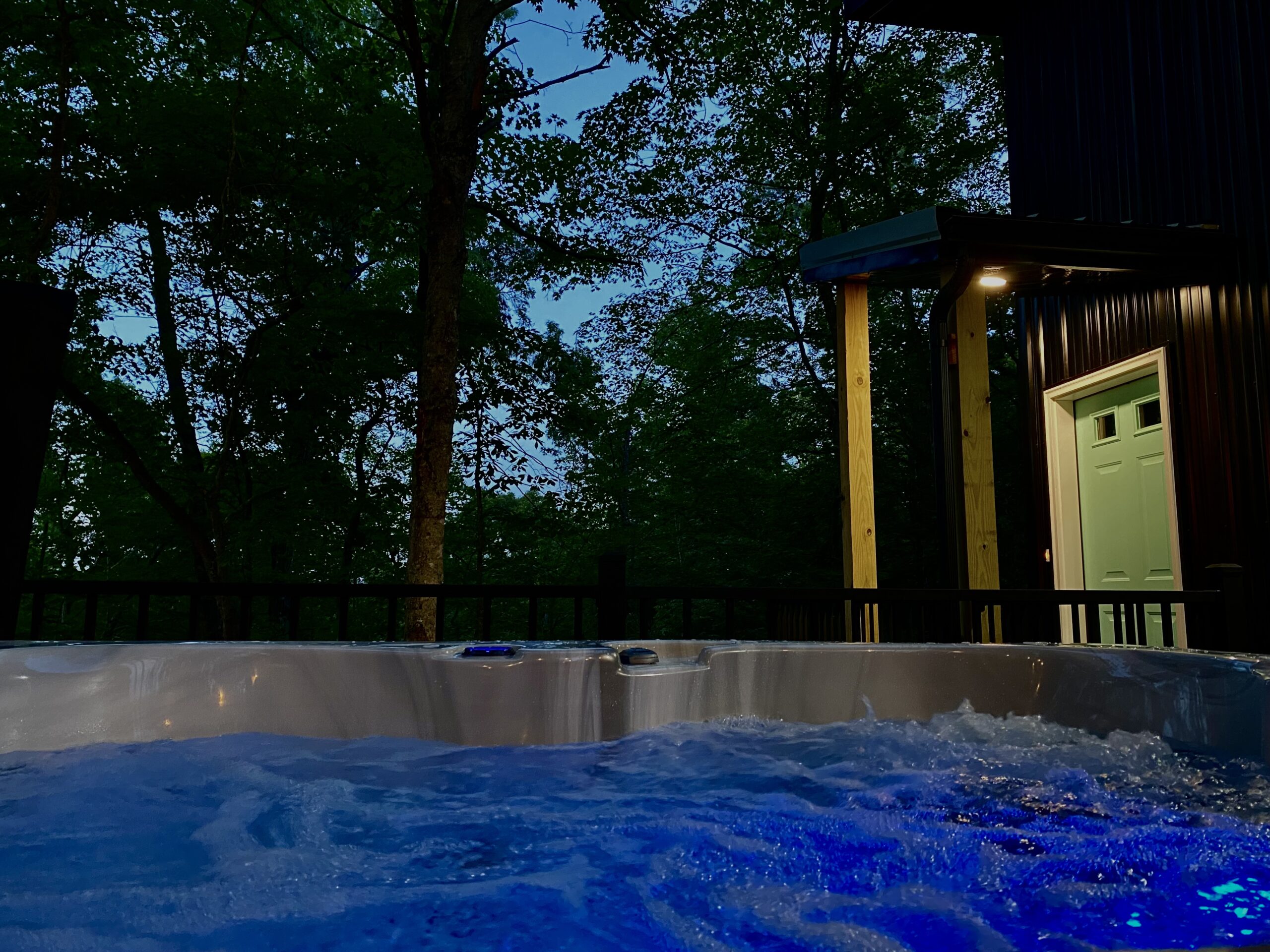
Both Canopy 7 and Canopy 9 at Vacation Alchemist sit perched above the forest floor with unobstructed canopy views and very little ambient light. On a clear night, the sky from the deck is the kind of thing that makes people set an alarm for 2am just to see it again. The hot tub is heated. The forest is quiet. There is nowhere you need to drive, no headlamp required, and no one else on the trail.
For a lot of guests, that combination ends up being the memory they talk about when they get home.
What to Bring for a Stargazing Night at the Gorge
A few things make the difference between a good look at the sky and an actual experience worth planning around.
A red-light headlamp is the first thing on the list. White light destroys your night vision immediately and takes 20 to 30 minutes to recover. Red light preserves it. Almost every outdoor shop near the Gorge carries them, and they are worth picking up before you head out on trail after dark.
A stargazing app on your phone helps enormously if you want to identify what you are seeing. Stellarium is free and accurate. Sky Map works well for quick orientation. Both use your phone’s GPS and compass to show you exactly what is overhead. Use the app in red-light mode if your phone allows it, or just dim the screen as much as possible.
Layers matter more than most people expect. Summer evenings in the Gorge can feel warm at sunset and drop significantly by midnight, especially on the ridge. If you are hiking to an overlook, pack a mid-layer and do not assume the temperature you left the trailhead in is the temperature you will be standing in two hours later.
A ground cloth or a blanket for lying flat is worth every bit of space it takes in your bag. Looking straight up is a different experience from craning your neck, and after about ten minutes you will appreciate not having to.
Water, snacks, and your fully charged phone round out the basics. Tell someone where you are going if you are hiking a ridgeline after dark.
A Few Honest Notes on Expectations
Cloud cover is the wildcard. Eastern Kentucky is beautiful and also genuinely prone to overcast nights, especially in the summer months. Checking a detailed hourly forecast (not just the daily summary) before committing to a ridgeline hike after dark will save you some frustration. Apps like Clear Outside are built specifically for astronomical viewing conditions and give you cloud cover by altitude, which is more useful than a basic weather app.
Humidity also affects visibility. The nights with the best seeing tend to come after a cold front moves through, when the air is drier and steadier. A slightly cooler night in September can outperform a warm, humid August night even at the same moon phase.
And if you get out there and it is cloudy? The forest at night has its own thing going on. The sounds are different. The fireflies, earlier in the summer, put on a show of their own. A fire pit and a hot tub and the dark silence of the canopy above is not a consolation prize.
Frequently Asked Questions
Is Red River Gorge a dark sky area?
Red River Gorge is not an officially designated International Dark Sky Park, but it sits within the Daniel Boone National Forest in a low-population corridor of eastern Kentucky that produces genuinely dark skies on clear nights. Light pollution from nearby towns is minimal, and the Milky Way is visible to the naked eye on moonless nights with good conditions.
When is the best time to stargaze at Red River Gorge?
The best conditions combine a new moon (or a moon that sets early), a clear sky, and low humidity. For the Milky Way’s galactic core, late July through early September offers the highest position overhead. The Perseid meteor shower typically peaks in mid-August and is one of the most reliable viewing events of the year from this location.
Do I need a telescope to stargaze at Red River Gorge?
No. On a clear, moonless night the Milky Way, major constellations, planets, and passing satellites are all visible with the naked eye. Binoculars add a nice layer of detail but are optional. A basic stargazing app on your phone is the most useful tool for identifying what you are seeing.
Can I stargaze from inside the park at night?
Natural Bridge State Resort Park has posted hours for trail access. Guests staying at Hemlock Lodge within the park may have access to cleared areas near the lodge after dark, but hiking the arch trail at night is not a standard after-hours activity. Check directly with the park for current guidelines. Privately managed areas outside the park (like the cabins at Vacation Alchemist) have no such restrictions.
What is the best overlook for stargazing without a long hike?
The Rock Bridge Scenic Picnic Area offers accessible dark-sky viewing with a short, manageable trail. For no hiking at all, an elevated cabin deck with unobstructed canopy views is the most practical option, and the one guests at Canopy 7 and Canopy 9 end up returning to night after night.